Try our *UPDATED* boardview, bios, & schematic search. Over 2.3 million files for download!

WARNING: Live heatsinks & single pole on/off switches in switching power supplies

Collapse
This is a sticky topic.
X
X
 
  • Time
  • Show
Clear All
new posts
  • Per Hansson
    Super Moderator
    • Jul 2005
    • 5897
    • Sweden

    #1

    WARNING: Live heatsinks & single pole on/off switches in switching power supplies

    This is a warning to inexperienced and experienced techs alike:
    The De-facto standard is to have the primary side heatsink live in switching power supplies.
    That is the primary side heatsink is referenced to the negative of the bulk filtering capacitor.
    Therefore never ever touch the heatsink if the device is plugged in.
    And even if it is unplugged let the capacitor discharge first!

    Another really serious concern is that the power switch also by De-facto standard is single pole.
    This means it only cuts power to the phase or neutral (not both) depending which way you have it plugged in if you have a Schuko plug or another non-polarized plug.
    This means that when the device is switched off you will read 230VAC on the primary side heatsink to ground! (Or 115VAC if that is your mains voltage).

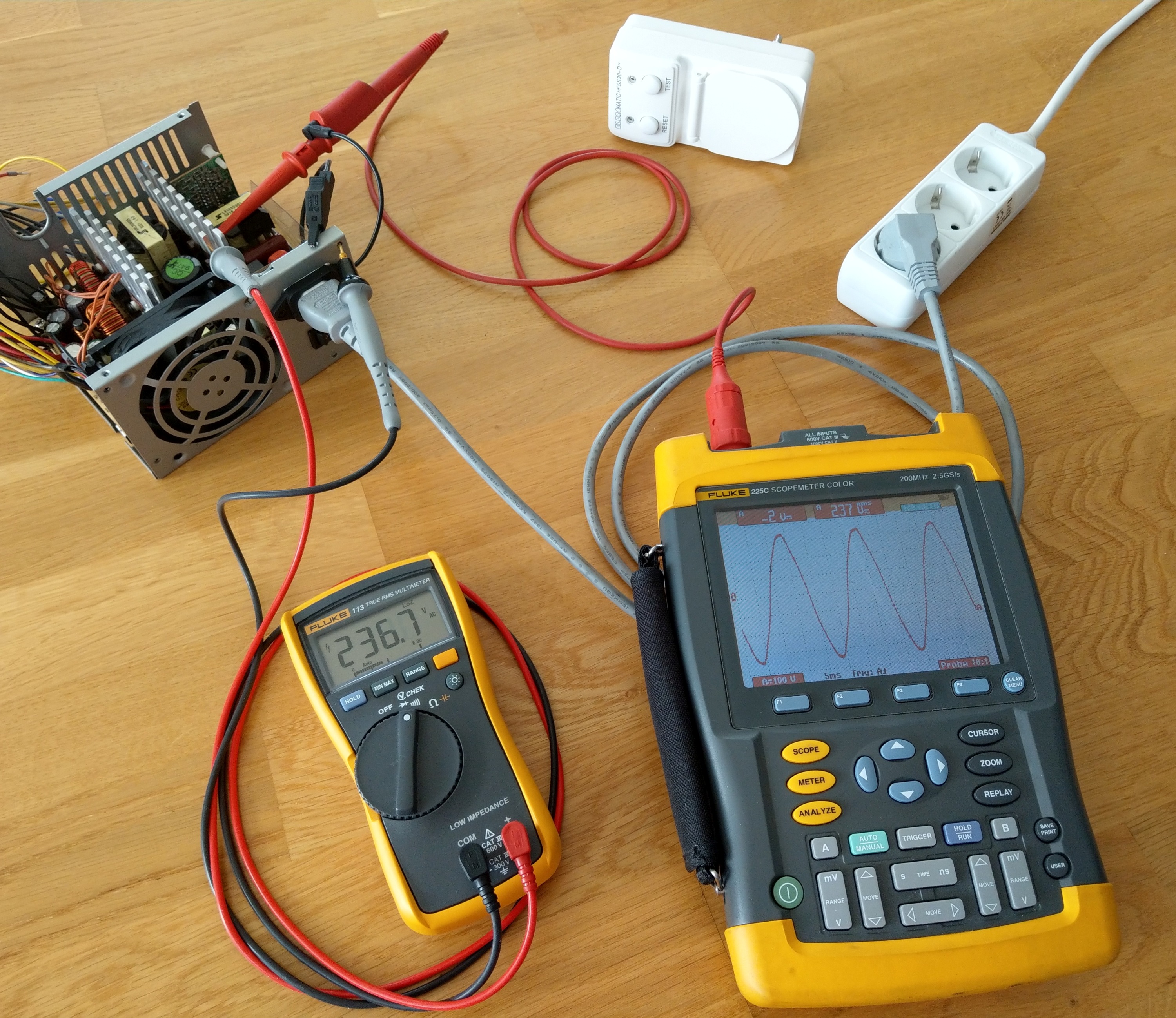
    In the following picture I show a Fluke 113 measuring the voltage, I'm using this as it has a 3KΩ measurement impedance, so it presents a quite heavy load to the circuit being measured.
    This is to allow you to understand that it is a real voltage we are speaking about and not a phantom floating voltage as you can sometimes see in house wiring.
    Indeed it is large enough that I can't use the 30mA RCD you also see in the picture: because it will trip!
    Then I also use a Fluke 225C Scopemeter to show the actual waveform.

    Here is the voltage of the primary heatsink with relation to ground with the unit switched off on the single pole switch:
    As you can see we are reading 237VAC (our line voltage)

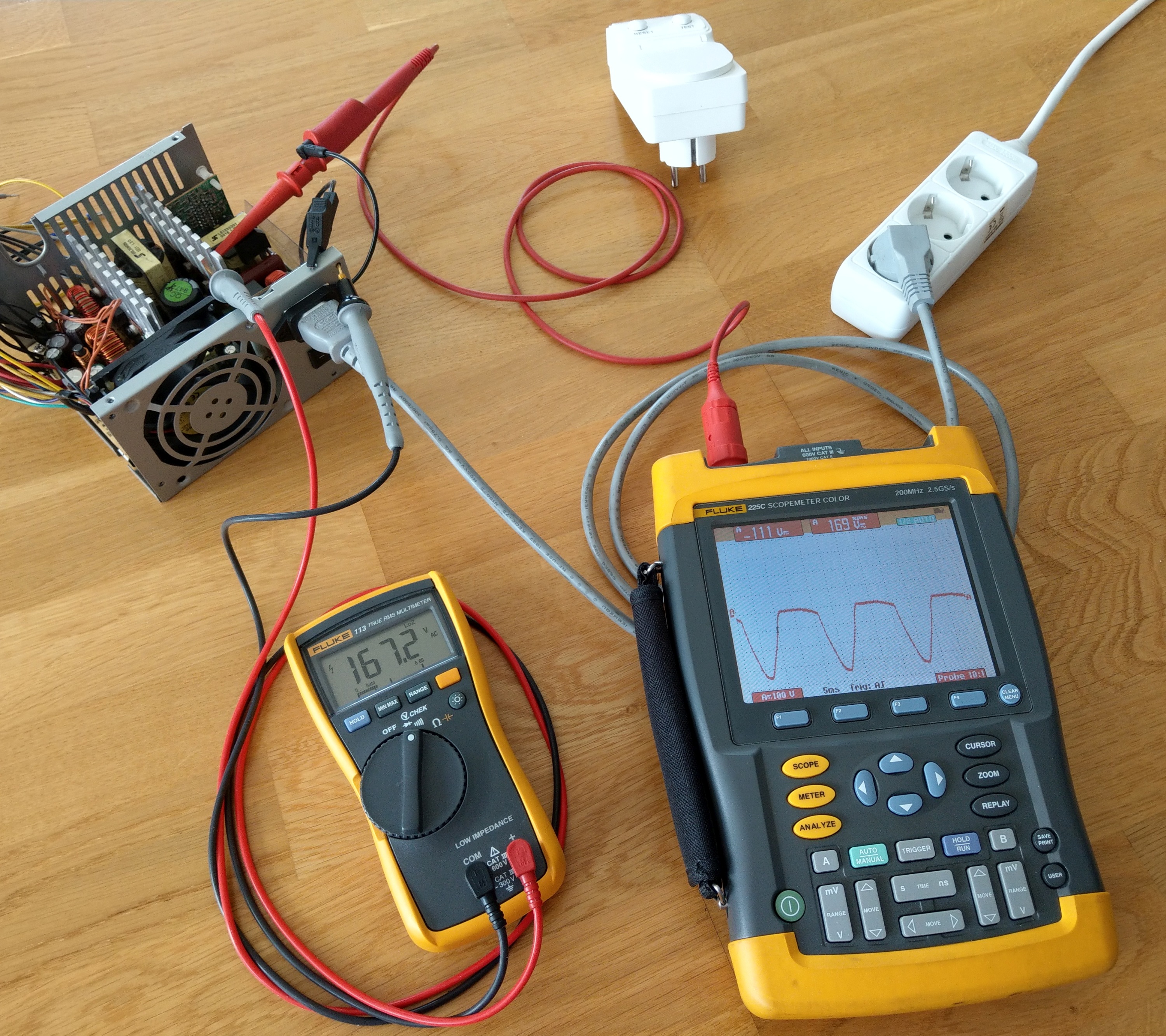
    And here is the voltage waveform of the primary heatsink with relation to ground with the unit switched on:
    (As you can see the meters show a voltage of roughly 167VAC but this is a RMS approximation that is not so useful).
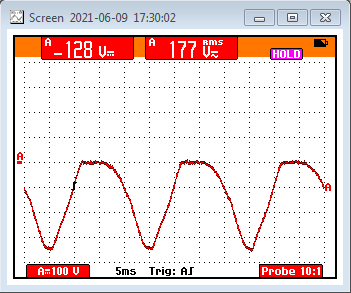

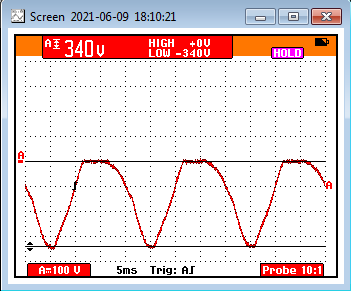
    The actual DC voltage is of course our rectified AC voltage that is close to 340VDC due to my slightly high line voltage (√2 x 240VAC = 339.4VDC)
    I've added some cursors here to better clarify what I mean:

    It is also extremely important to point out that the only safe way to measure on the primary side with an oscilloscope is using a differential probe or with a Scopemeter that is not referenced to mains ground.
    Because if we wanted to get a useful reading here we would need to clip the negative lead to the primary side heatsink since that is the negative of the primary side.
    And I hope you understand now why that would end extremely badly, if not please watch EEVblog #279 - How NOT To Blow Up Your Oscilloscope!
    Attached Files

    Premium supporters get full download access and other benefits.

    Last edited by Per Hansson; 06-09-2021, 12:03 PM.
    "The one who says it cannot be done should never interrupt the one who is doing it."
  • dicky96
    Sun Seeker
    • Mar 2017
    • 1828
    • Spain

    #2
    Re: WARNING: Live heatsinks & single pole on/off switches in switching power supplies

    It is also extremely important to point out that the only safe way to measure on the primary side with an oscilloscope is using a differential probe or with a Scopemeter that is not referenced to mains ground.
    Or use an isolation transformer? An excellent post regarding the dangers, nevertheless
    Follow me on YouTube
    ------------------
    Learn Electronics Repair
    https://www.youtube.com/channel/UCFX...R8UZ2vg/videos

    Comment

    • momaka
      master hoarder
      • May 2008
      • 12190
      • Bulgaria
      • Fixing stuff

      #3
      Re: WARNING: Live heatsinks & single pole on/off switches in switching power supplies

      I've been repairing PSUs for years now and also been posting some of those repairs here for just as long... yet, it never occurred to me that we should have a warning like this as a sticky thread. But this was a really good idea and also very well written, Per! I'm glad you posted it.

      Hopefully this should save us (well, me for sure ) some typing to warn people when they need to poke on the primary side. Now I can just refer them to this thread, instead. Although it should go without saying that doing any measurements on the primary side of a plugged in device is dangerous... indeed I agree that many people don't realize that the primary heatsink is almost always live.

      That said, I have also seen the exception a few times where the primary heatsink wasn't connected to anything and just floating. So it's not live on *all* PSUs... but like you said, it is fairly standard practice with most manufacturers for it to be live. So when in doubt... just assume the primary heatsink is live. And even when not in doubt, it's still better to assume that it is live. All in all, it's *ALWAYS* a good idea to avoid touching any parts on the primary side of a PSU with your bare hands.

      Moreover, the primary heatsink can be especially dangerous, since it is indeed usually referenced to the negative lead of the primary cap... which means it will have a strong DC component to it. And while AC can penetrate the skin at lower voltages, at least it will usually make muscles on the body twitch. But with DC, there's a danger of muscles contracting one way and not being able to let go. So high voltage DC is something to especially beware of.

      Originally posted by Per Hansson
      Another really serious concern is that the power switch also by De-facto standard is single pole.
      This means it only cuts power to the phase or neutral (not both) depending which way you have it plugged in if you have a Schuko plug or another non-polarized plug.
      Yes.

      Moreover, even for countries/places that use polarized plugs - NEVER liberally assume that the wiring in your home was correctly installed. If you would like to use the power switch to turn Off power when working on a device, ALWAYS first verify that the specific plug you are using is correctly polarized. My personal opinion, however, is that one should not depend only on the power switch to disconnect power to the device that is being worked on, as it doesn't take much to accidentally turn On the switch. Unless a situation calls for it to use the power switch, it's always better to physically unplug the device.

      And to end on a slightly humorous note here, it should also be noted that the price/quality of a PSU doesn't necessarily mean that the PSU will use a DPST (dual-pole) power switch. For example, here's an old Deer DR-250ATX from the early 2000's that's probably not the best PSU in the world... yet, it has a dual pole switch that disconnects both Live and Neutral. I've also seen many higher-end PSUs with a single pole switch. So again, the build quality of the PSU is not necessarily relevant to the type of switch used on the AC line.
      Last edited by momaka; 06-14-2021, 08:36 PM.

      Comment

      • Dan81
        SNES-powered
        • Oct 2013
        • 1866
        • Romania

        #4
        Re: WARNING: Live heatsinks & single pole on/off switches in switching power supplies

        Originally posted by momaka;1052522
        And to end on a slightly humorous note here, it should also be noted that the price/quality of a PSU doesn't necessarily mean that the PSU will use a DPST (dual-pole) power switch. For example, here's an old [url=https://www.badcaps.net/forum/showpost.php?p=224299&postcount=490
        Deer DR-250ATX[/url] from the early 2000's that's probably not the best PSU in the world... yet, it has a dual pole switch that disconnects both Live and Neutral. I've also seen many higher-end PSUs with a single pole switch. So again, the build quality of the PSU is not necessarily relevant to the type of switch used on the AC line.
        I've seen those DPST switches in some higher end Allied-built Modecom units as well, though most of the others use the normal single pole switches, with the small note that they heatshrink them unlike the lower (bottom-of-the-barrel) units.
        Main rig:
        Gigabyte B75M-D3H
        Core i5-3470 3.60GHz
        Gigabyte Geforce GTX650 1GB GDDR5
        16GB DDR3-1600
        Samsung SH-224AB DVD-RW
        FSP Bluestorm II 500W (recapped)
        120GB ADATA + 2x Seagate Barracuda ES.2 ST31000340NS 1TB
        Delux MG760 case

        Comment

        • s675
          Member
          • Sep 2015
          • 36
          • UK

          #5
          Re: WARNING: Live heatsinks & single pole on/off switches in switching power supplies

          Here in the UK most of our circuit breakers at the main board (consumer unit) are single pole. If the incoming supply before the board is reversed, you end up with the situation where everything remains live.

          Our wall sockets have switches but a lot of them are also single pole, so with the reversed incoming connection, you can turn off the PSU switch, turn off the switch at the socket, and turn off the circuit breaker, and the PSU will still be at 240v unless its switch is on the neutral (quite common).

          Also, I learned this heatsink live situation the hard way yesterday!
          Last edited by s675; 08-29-2021, 08:37 AM.

          Comment

          • Th3_uN1Qu3
            Believe in
            • Jul 2010
            • 6031
            • Romania
            • electronics and DJing/producing music

            #6
            Re: WARNING: Live heatsinks & single pole on/off switches in switching power supplies

            It's the same here in Romania although the last couple of breakers I bought were double pole. Nothing about it on the box though, you'd have to take it out and look at the diagram printed on it.
            Originally posted by PeteS in CA
            Remember that by the time consequences of a short-sighted decision are experienced, the idiot who made the bad decision may have already been promoted or moved on to a better job at another company.
            A working TV? How boring!

            Comment

            • RJARRRPCGP
              Badcaps Legend
              • Jul 2004
              • 6306
              • USA

              #7
              Re: WARNING: Live heatsinks & single pole on/off switches in switching power supplies

              Looks like over here in the Americas, having only the neutral switched and the hot, not connected to a pole, can end extremely badly.

              It can turn the device that you're working on into a "series-multiplier", causing equipment to get blown out in the building.
              "¡Me encanta sinestesia!" -Mí mismo

              "I can use my synesthesia to tune an instrument"- Me

              Comment

              Related Topics

              Collapse

              • Per Hansson
                WARNING: Live heatsinks & single pole on/off switches in switching power supplies
                by Per Hansson
                This is a warning to inexperienced and experienced techs alike:
                The De-facto standard is to have the primary side heatsink live in switching power supplies.
                That is the primary side heatsink is referenced to the negative of the bulk filtering capacitor.
                Therefore never ever touch the heatsink if the device is plugged in.
                And even if it is unplugged let the capacitor discharge first!

                Another really serious concern is that the power switch also by De-facto standard is single pole.
                This means it only cuts power to the phase or neutral (not both) depending...
                06-09-2021, 12:01 PM
              • Richelsdorfite
                ASUS ROG Strix SCAR 17 G733QS — Persistent Freeze / Abnormal Power Draw — Seeking Help
                by Richelsdorfite
                System
                • Model: ASUS ROG Strix SCAR 17 G733QS-HG082T (2021)
                • Motherboard: Compal/Inventec 6050A3250201/6050A3250203, Rev 2.0/2.1
                • CPU: AMD Ryzen 9 5900HX
                • GPU: NVIDIA RTX 3080 Laptop (16GB)
                • RAM: 64GB (2x32GB) DDR4-3200 SO-DIMM
                • Storage: 2x NVMe M.2 2280 SSDs
                • BIOS: Version 335 (EC: G733QSEC.050)
                • Acquired: second-hand; previous owner had applied liquid metal on the CPU without proper protocol (uninsulated, contacts corroded)
                Main symptom (the one that matters most)

                System freezes with DPC_WATCHDOG_VIOLATION whenever any storage device is accessed — reproducible on:
                • Windows
                ...
                07-21-2026, 11:40 PM
              • ivtec
                Single Pole switch for audio help
                by ivtec
                Hi guys i built a small 6 watt audio amp for my PC but did not put a sound switch on it, but i need to put a 2 pole switch between amp and speakers on the cable itself , do i use the positive side or negative side? .Thanks
                06-11-2024, 01:00 PM
              • mcraze123
                Ubiquiti AmpliFi Alien (amplifi-xg) - Dead 2.4 GHz Band Traced to Shorted Buck Regulator MLCC (Repair Log)
                by mcraze123
                Had an interesting board-level repair come across the bench on an Ubiquiti AmpliFi Alien (amplifi-xg) mesh router. Documenting the diagnostic steps and rail measurements here in case someone else runs into a missing 2.4 GHz band on these units. Symptoms & Initial Troubleshooting
                • Symptom: 2.4 GHz Wi-Fi band completely disappeared overnight. 5 GHz / Wi-Fi 6 band and ethernet switching operated normally.
                • Standard software troubleshooting (factory resets, firmware re-flashes, NVRAM review) had already been performed with no change. OEM tech support had written it off as a dead Qualcomm baseband
                ...
                10-30-2026, 01:30 PM
              • Loading...
              • No more items.
              Working...